Securing funding and maintaining financial stability are crucial for any arts organization. A well-crafted budget proposal is often the gateway to grants, sponsorships, and effective resource allocation, demonstrating fiscal responsibility and a clear vision. Understanding how to structure this essential document can make all the difference in achieving your artistic and operational goals. This article will guide you through the components of a robust arts organization proposed budget template, ensuring your financial narrative is clear, compelling, and ready for scrutiny.
We’ll explore key sections, provide practical tips, and even offer a sample structure to help your organization present its financial needs with confidence. Mastering your budget proposal ensures transparency and builds trust with potential funders, stakeholders, and your community. A detailed and accurate budget document is not just about numbers; it tells the story of your organization’s financial health and its capacity to deliver impactful artistic programs.
Understanding Financial Planning for Arts Non-Profits
Effective financial planning is the bedrock of a sustainable arts organization. Unlike for-profit businesses, arts non-profits often rely on a diverse mix of income streams, including grants, donations, ticket sales, and program fees. Each of these revenue sources comes with its own set of reporting requirements and expectations, making a clear and comprehensive budget an absolute necessity.
A meticulously planned budget helps you allocate resources wisely, track expenses, and forecast future financial needs. It serves as a vital tool for internal management, guiding daily operations and strategic decisions. Furthermore, external stakeholders like grant committees, donors, and board members depend on this document to assess your organization’s stability and potential impact.
Developing a robust financial plan involves more than just listing numbers; it requires foresight and a deep understanding of your organization’s mission and programs. You need to project both income and expenses accurately, considering variables like seasonal programming, grant cycles, and potential economic shifts. This proactive approach ensures your organization can withstand financial pressures and continue its important work.
Key components of sound financial planning include:
- **Revenue Forecasting:** Estimating income from all sources, including earned revenue (ticket sales, merchandise) and contributed revenue (grants, individual donations).
- **Expense Tracking:** Categorizing and monitoring all operational and programmatic costs, from artist fees to marketing and administrative overhead.
- **Cash Flow Management:** Ensuring sufficient funds are available to meet short-term obligations and avoid liquidity issues.
- **Contingency Planning:** Setting aside reserves for unexpected expenses or revenue shortfalls, providing a crucial safety net.
By prioritizing these elements, arts organizations can build a resilient financial foundation that supports their artistic endeavors for years to come. A strong **arts organization proposed budget template** will integrate these principles effectively.
Structuring Your Arts Grant Budget Proposal
When preparing a grant application, the budget section is often as critical as the narrative describing your project. Funders want to see how their money will be used, and a well-structured budget proposal clearly communicates your financial needs in an organized and transparent manner. This section should directly align with the activities outlined in your project proposal, demonstrating a logical connection between your requested funds and planned outcomes.
Start by categorizing your expenses into logical groups. This usually includes personnel costs, administrative expenses, program-specific costs, and indirect costs. For each category, provide specific line items and justify the amounts requested. For instance, under personnel, list individual roles, their salaries or hourly rates, and the percentage of their time dedicated to the project.
Remember to include both cash and in-kind contributions. In-kind support, such as donated space, volunteer hours, or pro-bono services, demonstrates broad community support and can significantly strengthen your proposal. While these do not require direct grant funding, they show the overall value and leverage your project brings. This detailed approach is vital when using an arts organization proposed budget template.
Sample Arts Organization Proposed Budget Template
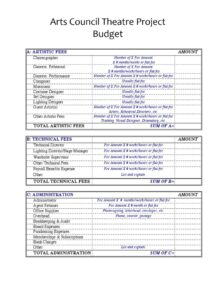
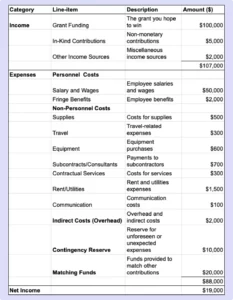
A clear and well-organized budget template simplifies the financial planning process for any arts organization. This sample structure provides a comprehensive framework, ensuring all essential revenue and expenditure categories are considered. It helps grant writers and financial managers present their fiscal needs with clarity and professionalism. The following layout is designed to be adaptable for various artistic projects and operational needs.
Income (Revenue) Projections
This section details all anticipated income streams that will support the organization’s activities for the proposed period. It’s crucial to be realistic yet thorough in your estimations.
| Revenue Category | Source | Amount Proposed | Notes |
|---|---|---|---|
| **Earned Revenue** | |||
| Ticket Sales | (e.g., General Admission, Subscriptions) | $X,XXX | Estimate based on attendance and pricing |
| Program Fees | (e.g., Workshops, Classes) | $X,XXX | Based on enrollment projections |
| Merchandise Sales | (e.g., T-shirts, Art Prints) | $X,XXX | Projected sales per event/quarter |
| Concessions | (e.g., Drinks, Snacks) | $X,XXX | Estimated sales per event |
| Rental Income | (e.g., Venue rentals) | $X,XXX | Based on booked rentals |
| **Contributed Revenue** | |||
| Grants – Government | (e.g., NEA, State Arts Council) | $X,XXX | Confirmed or highly anticipated grants |
| Grants – Foundation | (e.g., Local Community Foundation) | $X,XXX | Pending or awarded foundation grants |
| Corporate Sponsorships | (e.g., Local Businesses) | $X,XXX | Confirmed or pledged sponsorships |
| Individual Donations | (e.g., Annual Fund, Major Gifts) | $X,XXX | Based on fundraising goals and history |
| Special Event Fundraising | (e.g., Gala, Auction) | $X,XXX | Net proceeds from fundraising events |
| **Other Revenue** | |||
| Interest Income | (e.g., Savings accounts) | $X,XXX | Minimal, if applicable |
| **Total Proposed Income** | **$X,XXX** | Sum of all projected revenue |
Expenses (Expenditures) Breakdown
This part details all anticipated costs associated with running the organization and its programs. Be as specific as possible for each line item.
| Expense Category | Item/Description | Amount Proposed | Notes |
|---|---|---|---|
| **Personnel Costs** | |||
| Salaries | (e.g., Executive Director, Program Manager) | $X,XXX | Breakdown by role and percentage of time |
| Artistic Fees | (e.g., Artists, Performers, Curators) | $X,XXX | Per project/performance or contract rate |
| Contractors/Consultants | (e.g., Grant Writer, Accountant) | $X,XXX | Hourly rate or project fee |
| Benefits | (e.g., Health insurance, Payroll taxes) | $X,XXX | Applicable to salaried staff |
| **Administrative Costs** | |||
| Rent/Mortgage | (e.g., Office, Studio Space) | $X,XXX | Monthly or annual cost |
| Utilities | (e.g., Electricity, Water, Internet) | $X,XXX | Estimated monthly usage |
| Office Supplies | (e.g., Paper, Ink, Software) | $X,XXX | General office needs |
| Insurance | (e.g., General Liability, D&O) | $X,XXX | Annual premiums |
| Professional Fees | (e.g., Legal, Accounting) | $X,XXX | As needed services |
| **Programmatic Costs** | |||
| Materials/Supplies | (e.g., Art supplies, Exhibition materials) | $X,XXX | Specific to projects |
| Venue Rental (Program) | (e.g., Performance hall rental) | $X,XXX | For specific events/programs |
| Marketing & PR | (e.g., Advertising, Social Media Ads) | $X,XXX | Promoting events and programs |
| Travel & Accommodation | (e.g., Artist travel) | $X,XXX | For specific program needs |
| Equipment Rental | (e.g., Sound, Lighting, Projectors) | $X,XXX | For specific events/programs |
| Printing & Publications | (e.g., Programs, Brochures) | $X,XXX | For specific events/programs |
| **Indirect Costs (Overhead)** | |||
| Allocated Overhead | (e.g., % of administrative costs) | $X,XXX | Often a percentage of total direct costs |
| **Total Proposed Expenses** | **$X,XXX** | Sum of all projected expenses |
Budget Summary
This section provides a quick overview, ensuring that total income matches total expenses, or clarifies any requested grant amount.
- Total Proposed Income: $X,XXX
- Total Proposed Expenses: $X,XXX
- Net (Income – Expenses): $0 (or Requested Grant Amount)
This structured approach, using an arts organization proposed budget template, provides a comprehensive financial snapshot. It offers transparency and ensures that all aspects of your organization’s financial needs are clearly articulated to stakeholders and potential funders. Tailor the specific line items to fit your unique organization and project.
Preparing a detailed and accurate budget proposal is an invaluable skill for any arts organization. It not only streamlines your internal financial management but also significantly enhances your credibility with external funders and partners. By diligently tracking revenues and expenses, forecasting needs, and presenting this information clearly through an organized arts organization proposed budget template, you lay a strong foundation for sustainable growth and continued artistic impact.
Remember that your budget is a living document, requiring periodic review and adjustment as your projects evolve and new opportunities arise. Embrace this essential tool as a cornerstone of your organization’s success, empowering you to continue enriching communities through art.