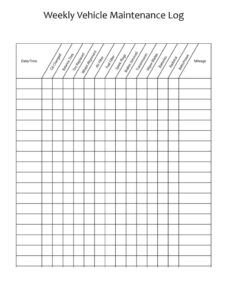
In an era where fuel prices fluctuate unpredictably and environmental consciousness is on the rise, understanding and managing your vehicle’s fuel consumption is more important than ever. Whether you drive for personal errands, daily commuting, or business purposes, keeping a close eye on your fuel usage can lead to significant savings and a better understanding of your vehicle’s health. A well-designed vehicle fuel consumption log template serves as an indispensable tool for achieving these goals, providing a clear snapshot of your automotive expenses and performance.
This comprehensive guide will explore the myriad benefits of diligently tracking your fuel usage. We will delve into what makes an effective fuel log and how to utilize the data you collect to make informed decisions about your driving habits and vehicle maintenance. By the end, you’ll not only understand the importance of a robust tracking system but also have insights into creating or selecting the perfect template for your needs.
Why Tracking Fuel Usage is Essential
Monitoring your fuel consumption goes far beyond just knowing how much you spend at the pump. It’s a proactive approach to vehicle ownership that empowers you with valuable data. Keeping a detailed fuel economy tracker helps you identify trends, address inefficiencies, and even extend the lifespan of your vehicle components. This practice is particularly beneficial for those managing multiple vehicles or business fleets, offering clear advantages for budgeting and operational efficiency.
Uncovering Hidden Costs and Savings
Many drivers are often surprised by the true cost of their daily commute or regular travels. A consistent mileage log reveals the cumulative impact of fuel expenses, which can be substantial over weeks or months. By meticulously recording each fill-up, you gain a transparent view of where your money is going, allowing you to pinpoint potential areas for cost reduction. This detailed financial insight is crucial for personal budgeting and for businesses aiming to optimize their operational expenses.
Understanding your average cost per mile or kilometer enables smarter route planning and fuel purchasing decisions. For instance, you might discover that a slight detour to a station with lower prices makes a measurable difference over time. This data can also highlight the impact of specific driving conditions, such as heavy city traffic versus highway cruising, on your overall fuel efficiency.
Improving Driving Habits and Efficiency
A vehicle fuel consumption log template acts as a powerful feedback mechanism for your driving style. When you consistently record fuel economy, you can directly correlate your driving habits with their impact on gas mileage. Aggressive acceleration, sudden braking, and excessive idling are known to decrease fuel efficiency, and your log will vividly illustrate this.
By reviewing your fuel usage spreadsheet, you might notice patterns where certain trips or types of driving result in poorer mileage. This awareness encourages smoother acceleration, maintaining steady speeds, and anticipating traffic, all of which contribute to better fuel economy. Implementing these changes not only saves money but also reduces wear and tear on your vehicle, promoting a safer and more environmentally friendly driving experience. Studies suggest that smooth driving can improve fuel efficiency by 10-15%.
Facilitating Vehicle Maintenance and Diagnostics
Beyond finances and driving habits, a well-maintained gas logbook is an invaluable tool for vehicle maintenance. A sudden and unexplained drop in fuel efficiency can be an early indicator of a mechanical issue. For example, a clogged air filter, worn spark plugs, or misaligned wheels can all negatively affect your car’s fuel consumption.
Regularly checking your fuel usage spreadsheet helps you spot these anomalies promptly, allowing for timely intervention before minor issues escalate into costly repairs. This proactive diagnostic capability means you can schedule maintenance based on actual performance data, rather than just mileage milestones. It ensures your car remains in optimal condition, enhancing reliability and potentially extending its operational life.
What to Include in a Fuel Log Template
Creating or choosing an effective fuel consumption log requires understanding the essential data points that will provide the most valuable insights. A comprehensive vehicle fuel consumption log template should be easy to use yet capture enough detail to make your tracking efforts worthwhile. Simplicity and clarity are key to ensuring consistent record-keeping.
Key Data Fields for Accuracy
To accurately track your fuel efficiency, several pieces of information are critical for each entry in your fuel log:
- Date of Fill-Up: Essential for chronological tracking and identifying trends over time.
- Odometer Reading: Records the total mileage of your vehicle at the time of refueling. This is crucial for calculating distance traveled between fill-ups.
- Fuel Type: Specifies whether you used regular, premium, diesel, or another fuel type, especially important if you sometimes switch.
- Volume of Fuel Added: The exact number of liters or gallons purchased. This is used in conjunction with the odometer reading to calculate fuel economy.
- Total Cost: The total amount spent on fuel for that transaction.
- Price Per Unit: The cost per liter or gallon, which helps compare fuel prices at different stations or over time.
- Location/Station: Useful for reviewing where you typically refuel and comparing prices.
- Notes/Comments: A free-form field for observations like “heavy traffic,” “AC used heavily,” “tire pressure check,” or “highway driving.” These notes can help explain variations in fuel economy.
Including these details ensures that you have a complete picture of each refueling event. Over time, this rich data allows for sophisticated analysis of your vehicle’s performance and associated expenses.
Benefits of Detailed Record-Keeping
Detailed record-keeping in a fuel log offers numerous advantages beyond basic tracking. It transforms raw data into actionable intelligence. For instance, calculating miles per gallon (MPG) or kilometers per liter (Km/L) after each fill-up provides immediate feedback on your recent driving and vehicle performance. This immediate feedback loop can reinforce positive driving habits and quickly alert you to issues.
Furthermore, a comprehensive vehicle expense record simplifies tax deductions for business use of a personal vehicle. It provides documented proof of fuel purchases and mileage, which is often required for reimbursement or tax purposes. This level of detail also makes it easier to compare the fuel efficiency of different vehicles if you own more than one, or if you are considering purchasing a new vehicle. The long-term insights gained from such thorough tracking are invaluable for any responsible vehicle owner.
Sample Vehicle Fuel Consumption Log Template
A practical vehicle fuel consumption log template doesn’t have to be complicated. It should be structured in a way that makes data entry quick and calculation straightforward. Below is a sample format that you can adapt for a spreadsheet, a dedicated notebook, or even a simple app. This template focuses on capturing all the key data fields discussed previously, allowing for easy calculation of fuel efficiency.
| Date       | Odometer (km/miles) | Fuel Type | Volume (L/gal) | Total Cost ($) | Price/Unit ($/L or $/gal) | Location/Station | Notes                               | Distance (km/miles) | Fuel Economy (L/100km or MPG) |
|------------|---------------------|-----------|----------------|----------------|-----------------------------|------------------|-------------------------------------|---------------------|-------------------------------|
| 2023-10-26 | 125,400             | Regular   | 45.0           | 75.60          | 1.68                        | Shell - Main St  | City driving, AC on                 | -                   | -                             |
| 2023-11-02 | 126,050             | Regular   | 42.0           | 69.30          | 1.65                        | PetroCanada      | Mix of highway/city                 | 650                 | 6.46 L/100km                  |
| 2023-11-09 | 126,800             | Regular   | 50.0           | 84.00          | 1.68                        | Esso - Hwy 401   | Long highway trip                   | 750                 | 6.67 L/100km                  |
| 2023-11-16 | 127,410             | Regular   | 40.0           | 68.00          | 1.70                        | Shell - Main St  | Heavy city traffic                  | 610                 | 6.56 L/100km                  |
| 2023-11-23 | 128,090             | Regular   | 43.5           | 73.08          | 1.68                        | Independent Gas  | Smooth driving, less AC             | 680                 | 6.40 L/100km                  |
To use this template effectively, always record the odometer reading at the time of refueling. The “Distance” column is calculated by subtracting the previous fill-up’s odometer reading from the current one. The “Fuel Economy” is then derived by dividing the “Volume” of fuel by the “Distance” traveled (for L/100km) or dividing “Distance” by “Volume” (for MPG). This systematic approach turns raw data into meaningful metrics.
This structured format makes it easy to visualize your fuel efficiency over time and quickly identify any significant changes. It’s also simple enough for anyone to maintain, ensuring consistency in your fuel efficiency tracking. You can expand or simplify this basic structure to best suit your personal preferences or specific tracking needs.
Embracing the habit of tracking your fuel consumption with a dedicated template is one of the smartest moves you can make as a vehicle owner. It provides clarity on your expenses, empowers you to refine your driving for better efficiency, and acts as an early warning system for potential mechanical issues. The insights gained from a comprehensive fuel usage spreadsheet can lead to substantial financial savings and prolong the life of your vehicle.
Begin implementing a vehicle fuel consumption log template today and start taking control of your automotive costs and performance. Whether you choose a digital spreadsheet or a physical logbook, the crucial first step is to start consistently recording your data. Over time, you’ll appreciate the detailed overview and the ability to make more informed decisions about one of your most significant investments.